Community Science

Unleashing Excellence: TRIAD & Precision Pack Members in the Spotlight!
Published on June 10, 2026The Dog Aging Project is powered by a diverse community of Pack members across several scientific cohorts.
Read More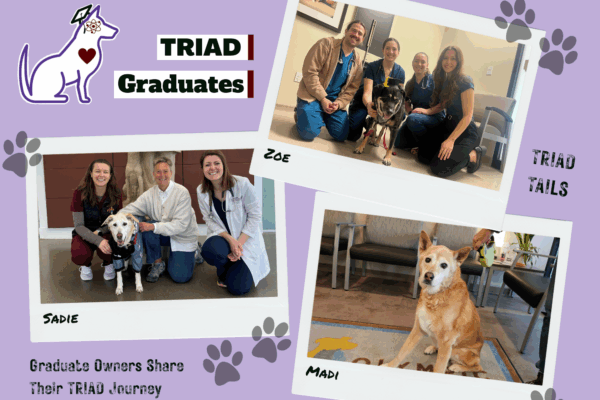
TRIAD Tails: Graduate Owners Share Their TRIAD Journey
Published on October 6, 2025Three of the earliest participants in the Test of Rapamycin in Aging Dogs (TRIAD) clinical trial had a common reason for enrolling their aging companion pet in the study: wanting to enhance their dog’s quality as well as quantity of life.
Read More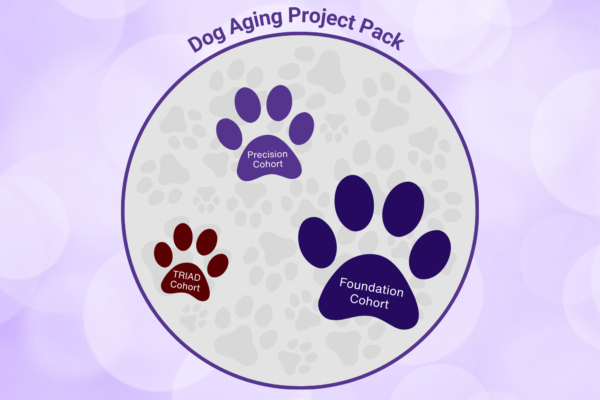
Inside Science: Consorting with Cohorts
Published on October 31, 2024In the Dog Aging Project, our different cohorts are different groups of dogs with characteristics that allow us to ask and seek answers to specific scientific questions.
Read More
Inside Science: Canine Sentinels
Published on October 25, 2024In this article at Science.org, our Dog Aging Project team members Courtney Sexton and Audrey Ruple lay the framework for how our close relationships with canine companions can offer an opportunity to learn how the combined elements of the physical and social environment contribute to the quality of life for both people and dogs.
Read More
Our Funding is Diverse, Just Like Our Pack! (An Update)
Published on August 30, 2024We want to thank you, our loyal participants, for supporting the Dog Aging Project as…
Read More
Open Data, Open Possibilities
Published on August 21, 2024The Dog Aging Project is powered by a diverse community of Pack members across several scientific cohorts.
Read More
“Life is a series of dogs” – New Opportunity to Nominate Another Dog!
Published on March 28, 2024We’ve got some exciting news! If your Pack member is no longer a part of your household for any reason, you now have the opportunity to enroll a subsequent dog in the Dog Aging Project longitudinal observational study!
Read More
Scientific Results: Lifetime prevalence of owner-reported medical conditions in the 25 most common dog breeds in the Dog Aging Project Pack
Published on December 8, 2023This paper looked at the most popular dog breeds in the Dog Aging Project (DAP) Pack and the mixed-breed dogs in the DAP Pack to identify which medical conditions owners are reporting most commonly in these different breeds. We also looked at the percentage of dogs in these breeds with no owner-reported medical conditions.
Read More
Standing out from the crowd: What makes the Dog Aging Project unique?
Published on October 24, 2023At its core, the Dog Aging Project is a long-term, longitudinal study looking at aging…
Read More
Scientific Results: A review of frailty instruments in human medicine and proposal of a frailty instrument for dogs
Published on August 14, 2023This paper is about frailty – a complex syndrome associated with aging that has become important in human healthcare and research. When humans experience loss of emotional and physical reserves, they are less able to bounce back from stressors. Frailty, even more than chronological age, is associated with increased risk of negative health outcomes and death. There are many different ways to measure or determine frailty in humans, and this paper gives a brief review of frailty in human medicine and research. Assessing frailty is important because while we cannot reverse chronological age, we can intervene to reduce or even reverse frailty. And hopefully, this will be true for dogs as well.
Read More